
In modern biology, the real bottleneck isn’t generating data — it’s turning data into decisions. And that work is rarely “just run a tool.” It’s coordination: translating fuzzy goals into executable steps, chasing missing inputs, choosing infrastructure, rerunning when something fails, and packaging results for the next decision-maker.
Take a request that sounds trivial:
“Run QC on these reads and summarize whether we should send the clones to our customer.”
In practice it becomes a multi-person loop:
- What does “QC” mean for this experiment?
- Where are the files — and are the sample labels trustworthy?
- Which pipeline is appropriate (FastQC + MultiQC, or something custom)?
- Where should it run (local vs. cloud vs. cluster)?
- How do we share results so the next iteration is obvious?
The compute is usually the cheapest part. The expensive part is the iteration: back-and-forth clarification, context switching across roles, reruns, and report revisions. We don’t just need faster pipelines — we need systems that preserve context, make execution routine, and make iteration cheap, so scientists and bioinformaticians can stay focused on the biology.
That’s the problem Helix.AI is built to attack.
What is Helix.AI?
Helix.AI is a multi-agent system for managing biotechnology data-analysis workflows. It offers an API and an AI-powered web application that turn natural-language intent into auditable workflows, route execution to the right environment, generate tools on demand, and return structured outputs with session history and job tracking.
The core idea is to stop thinking “chatbot” and start thinking “distributed team”: multiple agents with narrow responsibilities, exchanging typed outputs, operating under clear handoff and policy rules — with a human approving the plan before anything runs.
The agents: a distributed team, not a chatbot
Helix.AI uses specialized agents and services with non-overlapping responsibilities. It helps to group them by decision type — some decide what to do, others decide how and where, and one service is the only component allowed to cause side effects.
| Agent / component | Role | What it does |
|---|---|---|
| Intent detection | Classifier | Decides whether the user is asking a question or requesting execution, and routes accordingly. |
| Domain + workflow planning | What to do | Interprets the biological intent and compiles it into a structured, execute-ready workflow plan (steps, dependencies, required inputs/outputs). |
| Implementation planning | How to do it | Compiles the plan into an execution spec for the chosen environment (commands, containers, resources, retries). |
| Infrastructure decision | Where to run | Chooses the target environment with a confidence score and cost/latency tradeoffs. |
| Tool generation | Filling gaps | Creates a new tool or wrapper when no registered tool satisfies a required step, validated against expected schemas. |
| Execution broker (service, non-LLM) | Side effects | The only component allowed to submit jobs, perform I/O, monitor runs, and collect logs and artifacts into a result. |
| Reporting / visualization | Deliverables | Turns execution results into user-facing summaries, plots, and report-ready outputs. |
Agents are only half the story. What separates an agentic system from a generic LLM chat is grounded action: the ability to call real tools, inspect real files, and produce real artifacts. Tools are the agents’ “hands” — and a key anti-hallucination mechanism. Instead of making up results, Helix.AI runs a tool, validates outputs against schemas, and attaches the actual plots, tables, and files to the response.
What happens when a tool is missing?
Helix.AI ships with a core toolbox and a tool-generation fallback, so it can handle both common tasks and long-tail requests.
Built-in tools. Helix.AI exposes a schema-registered toolbox of roughly 16 bioinformatics tools (plus inventory and DNA-ordering utilities), spanning:
- Sequence analysis — multiple sequence alignment, variant generation, representative selection
- Phylogenetics — tree building and visualization, reference-sequence fetching (e.g., NCBI), annotation lookups (UniProt, GO enrichment)
- Transcriptomics — bulk RNA-seq and single-cell RNA-seq analysis
- Sequencing QC — read trimming/merging and FastQC quality analysis (including async job patterns)
- Cloning — plasmid visualization and representative selection
Beyond the schema registry, the routing layer now recognizes a much broader set of modalities — including ChIP-seq, ATAC-seq, variant calling, metagenomics, CRISPR screens, and tabular Q&A — so requests get mapped to the right capability even as coverage grows.
When no tool fits. Rather than giving up or forcing the user into CLI glue, Helix.AI can:
- Detect the gap — the planning layer determines that no registered tool satisfies a required step.
- Generate a tool — it creates a new implementation or a wrapper around an existing bioinformatics binary, targeted to the already-chosen infrastructure.
- Validate contracts — the generated tool must adhere to the expected input/output schema, so downstream agents can rely on structure, not prose.
- Return to execution — once the tool exists, Helix.AI executes normally through the execution broker and reports results.
Tool discovery, schemas, and the execution boundary follow an MCP-style (Model Context Protocol) pattern: the LLM proposes actions, but the system executes them through a tool interface that returns real artifacts — tables, plots, files, job IDs — not hallucinated text. This is the pattern that lets Helix.AI mix native tools, integrated capabilities, and self-generated tools without changing how it plans or executes.
Built for iteration: approvals, checkpoints, and history
The most important recent developments in Helix.AI are about safe, cheap iteration — the part of the workflow that actually costs teams time:
- Human-approval gate. Helix.AI proposes a plan in plain language and waits for explicit approval before anything runs. The agent proposes; a person decides.
- Workflow checkpoints. A workflow moves through explicit states — waiting for inputs, waiting for approval, executing, and failure recovery — so a run is never an opaque black box.
- Session history. Uploads, commands, and runs are persisted per session, preserving the full context of an analysis.
- Iterative rerun and diff. Changing a parameter patches the existing analysis and re-runs it, and runs can be diffed against prior ones — so refinement is a traceable step, not a disconnected restart.
- File intelligence at upload. Uploaded files (CSV, FASTA, VCF, single-cell matrices) are profiled automatically, so the system understands formats and schemas before planning.
Together, these make iteration cheap while keeping every result reproducible and auditable.
Where does Helix.AI run?
The infrastructure-decision layer selects the environment per run and explains the tradeoff. Today Helix.AI executes on Local, EC2, and EMR (for large, async jobs), with AWS Batch and Lambda on the roadmap. Because the execution broker centralizes all side effects, the same plan can target different environments without changing how it was authored.
A real multi-agent story: single-cell RNA-seq (SLE immune profiling)
To make this concrete, here’s an end-to-end flow using the “Single-Cell RNA-seq: SLE Immune Profiling” demo scenario — a PBMC immune-profiling study comparing SLE patients vs. healthy controls using a 10x Genomics gene-expression matrix. The analysis mirrors real projects:
- QC and filtering (UMIs, mitochondrial %, doublets)
- Normalization
- Dimensionality reduction + visualization (PCA → UMAP)
- Clustering + cell-type annotation (marker genes)
- Differential expression (ideally pseudobulk per cell type)
- Deliverables — UMAPs, marker dot plots, DEG tables, and composition summaries suitable for a slide or notebook
This scenario also demonstrates Helix.AI’s “needs-inputs → load data → run → report” loop: the system can’t execute until it has a data-matrix URI, so it first asks for the missing input, then (in demo mode) offers a one-click way to run with a synthetic, S3-backed dataset. The chain runs in order: intent detection → domain and workflow planning → implementation planning → infrastructure decision → execution → reporting — so the system stays safe, explicit, and auditable at every step.
From prompt to completed job: a UI walkthrough
The Helix.AI UI is designed around three ideas: natural-language input, persistent session context, and visibility into long-running jobs.
 The header surfaces backend health and quick access to Demo Scenarios, Examples, and the Jobs panel for long-running work.
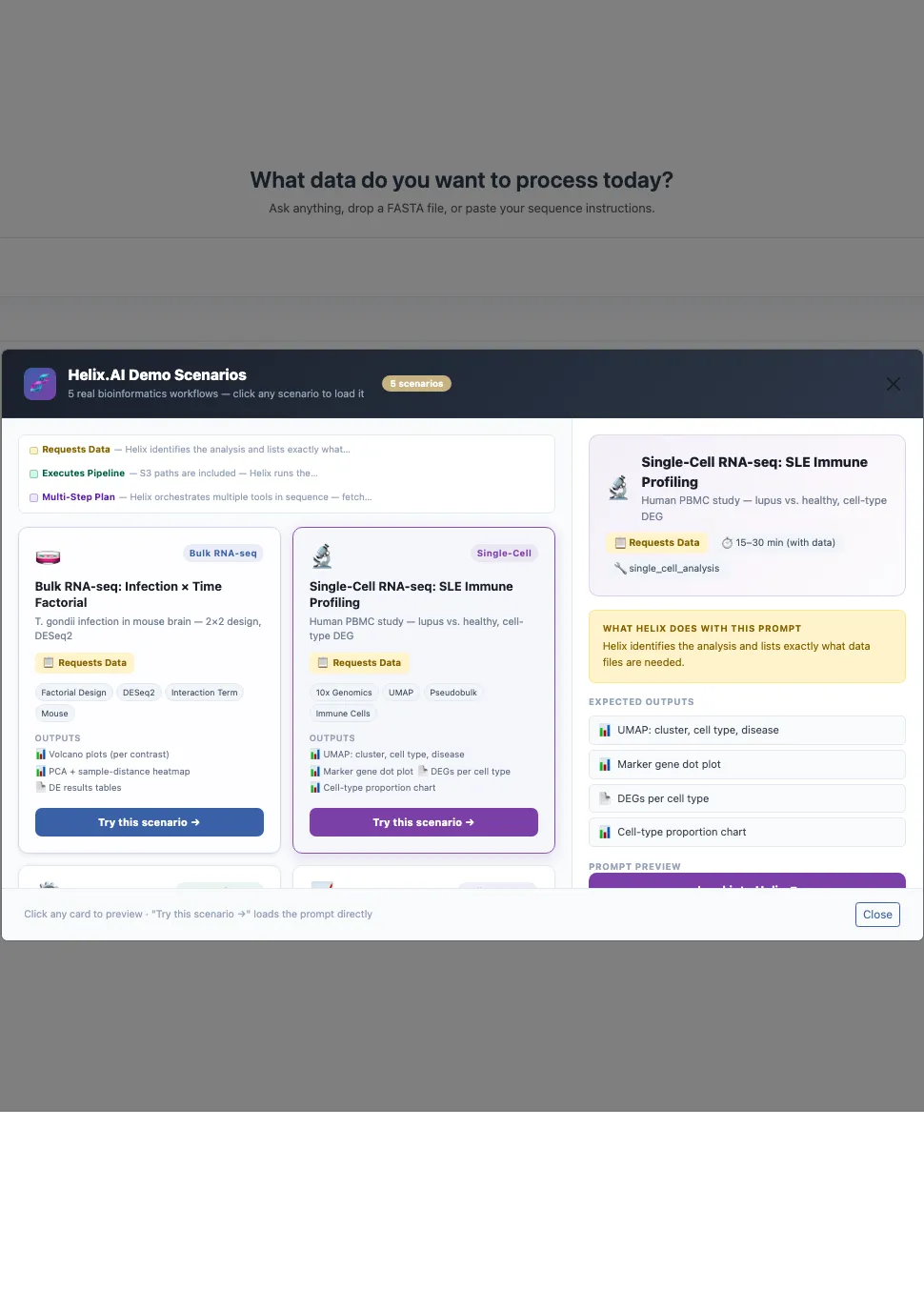 From Demo Scenarios, pick “Single-Cell RNA-seq: SLE Immune Profiling” to load a realistic scRNA-seq prompt (PBMC, SLE vs. healthy) with explicit expected outputs.
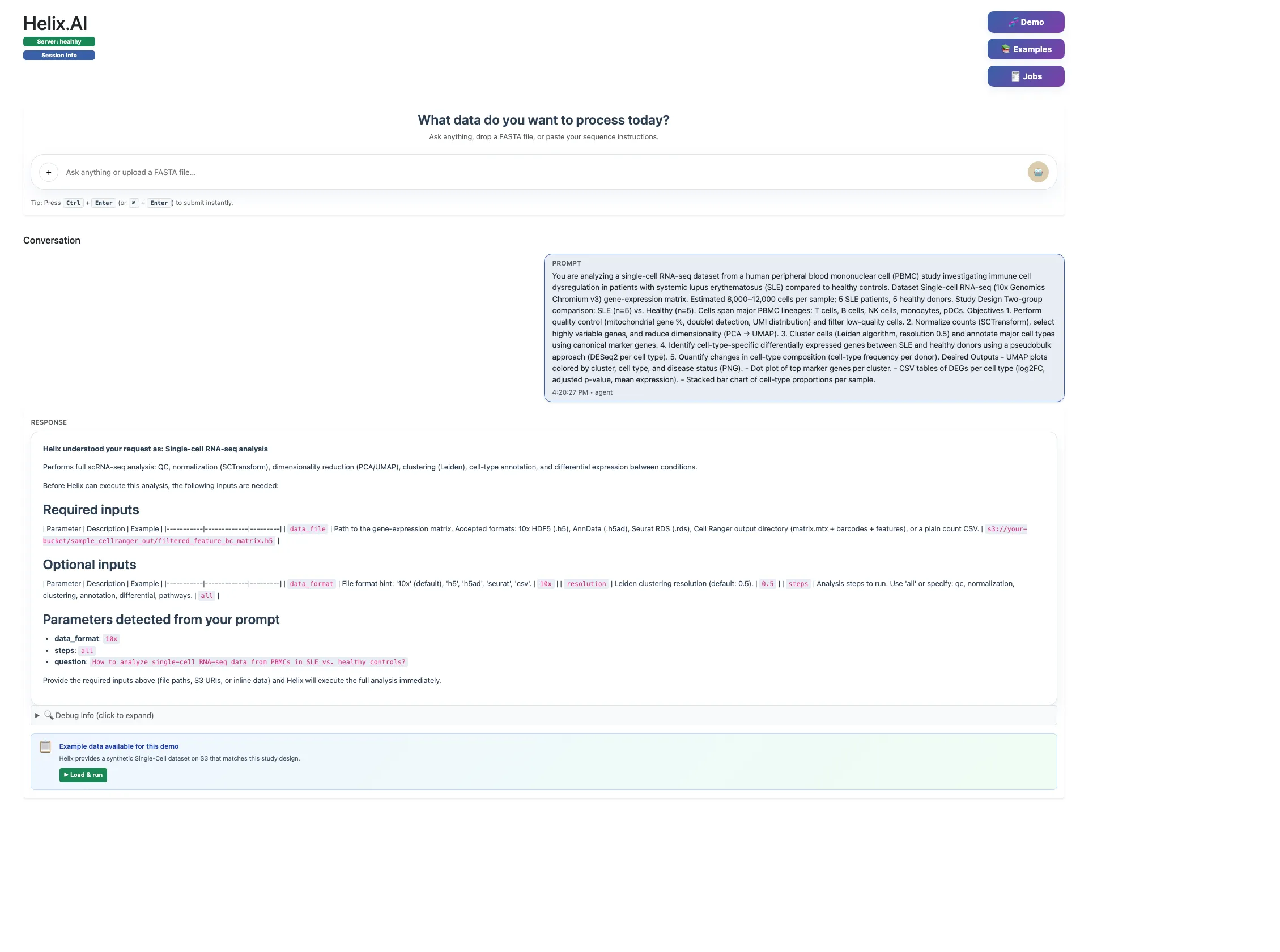 For single-cell workflows, Helix.AI first confirms the intent and lists required inputs (e.g., the 10x matrix). For demos, a helper card can load synthetic example data and run.
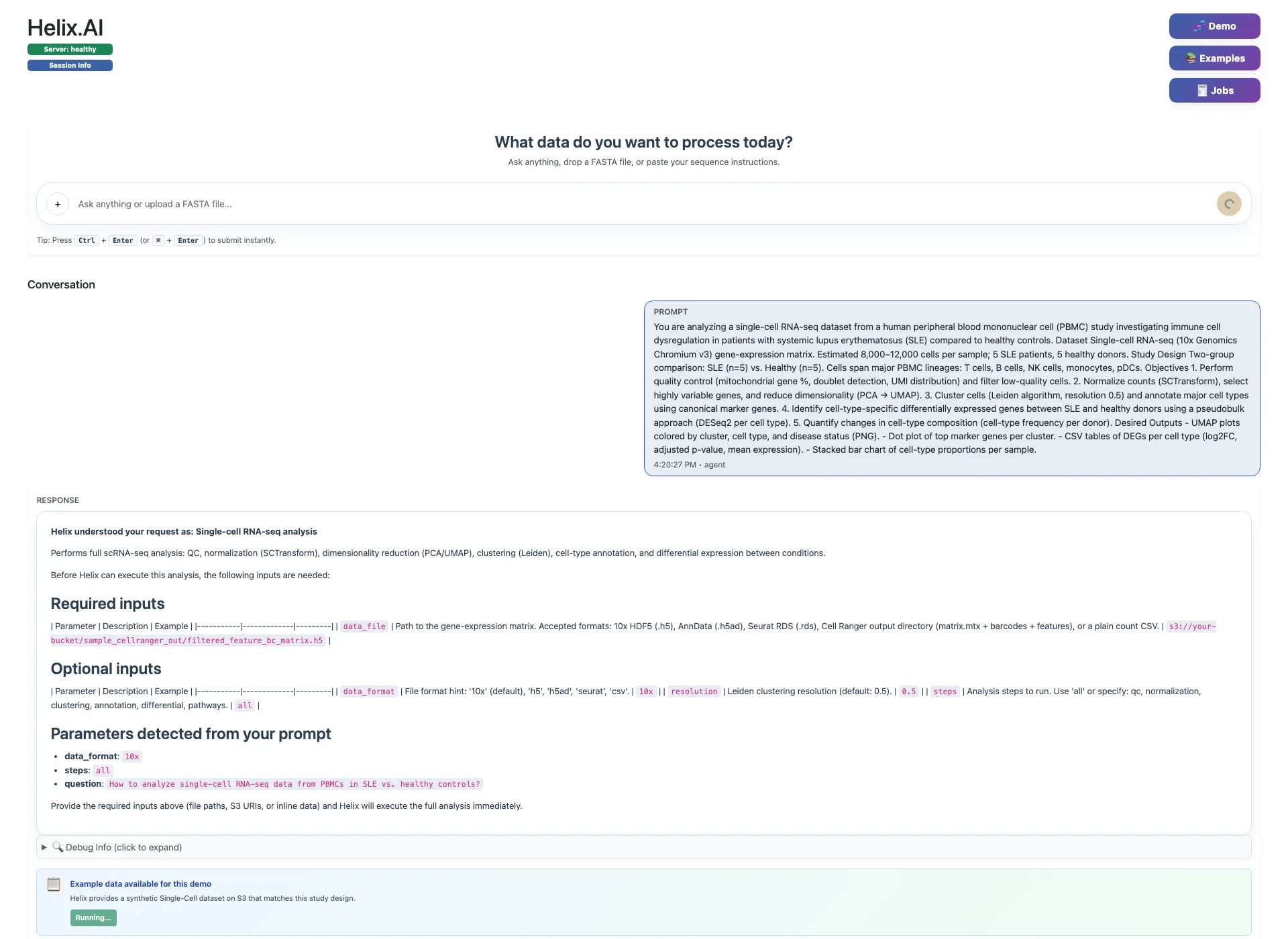 Once inputs are available, Helix.AI transitions into execution, showing clear progress feedback so the user doesn’t have to chase logs.
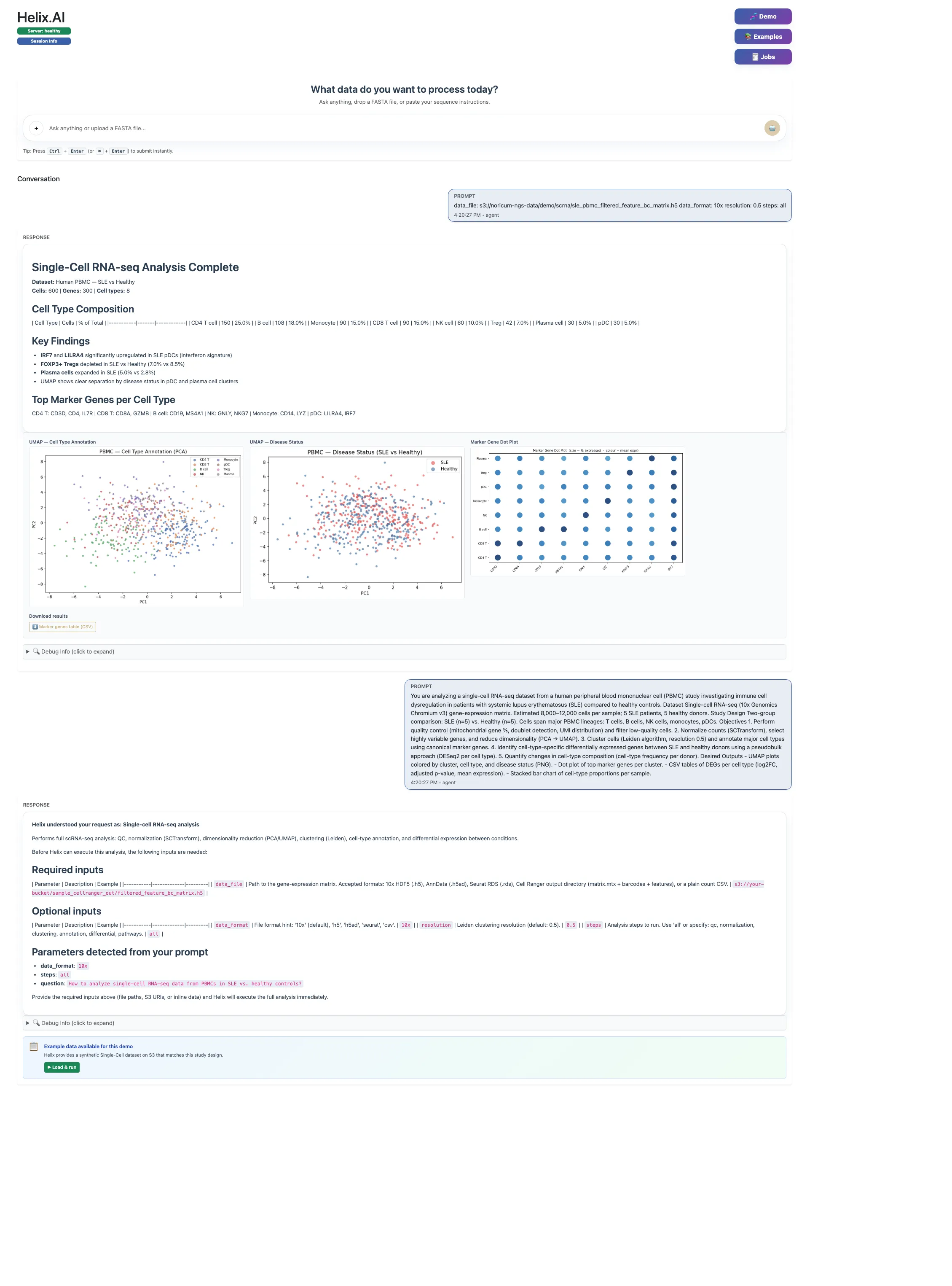 Helix.AI returns a compact, report-like output: dataset summary, cell-type composition, key findings, marker genes, visualizations, and downloadable artifacts.
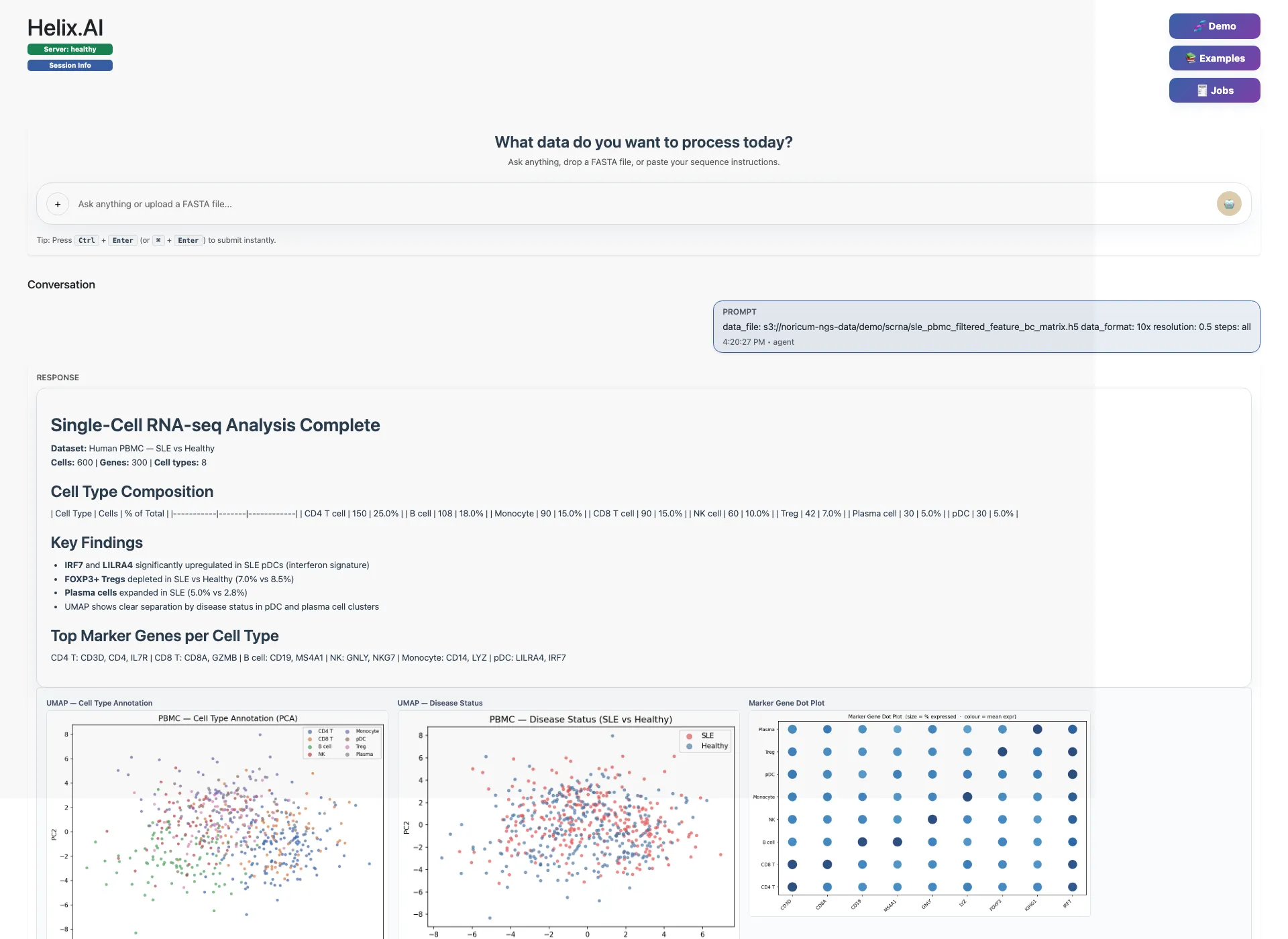 Long-running operations surface as asynchronous jobs; the Jobs panel provides durable job IDs, status, and results access.
Limitations (and why they matter in biotech)
Agentic systems are not a substitute for biological judgment. They’re a substitute for glue work:
- Humans still decide experimental framing, interpret results, and validate assumptions.
- Bad metadata and ambiguous requirements still produce bad outcomes — agents just make iteration cheaper and faster.
- The goal is not “full automation”; it’s fast, safe iteration with traceability.
Conclusion
Bioinformatics is ripe for automation with AI agents — not because biology is “easy,” but because so much of day-to-day work is tool-driven, iterative, and coordination-heavy. Agents fit that shape of work: they preserve context, compile intent into executable plans, handle long-running execution, and turn artifacts into decision-ready summaries.
Helix.AI is one of the first practical steps in that direction for biotech and pharma: an agentic system that treats analysis as an orchestrated workflow, keeps humans in the loop on scientific intent, and makes iteration cheaper from the very first prompt.
Helix.AI is open source and in private beta. Explore how it works, see use cases, or request beta access.